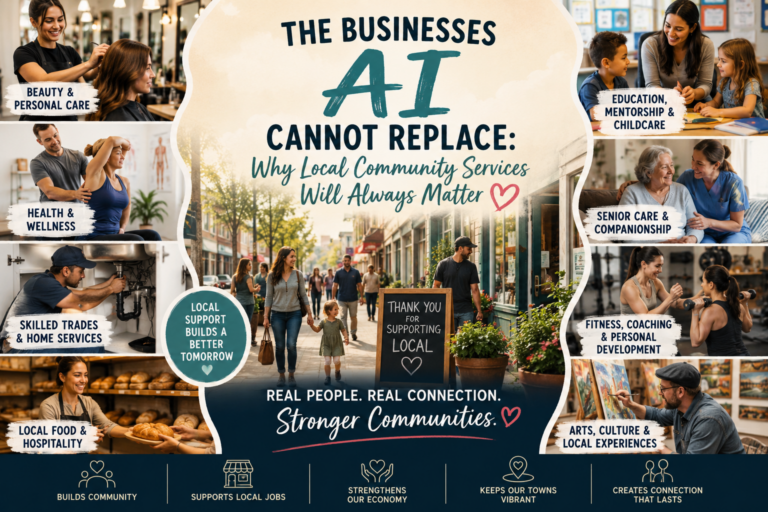
The Businesses AI Cannot Replace: Why Local Community Services Will Always Matter
Artificial Intelligence is rapidly changing the way the world works. Businesses are automating tasks, replacing repetitive labor, streamlining customer service, generating content, analyzing data, and even assisting with medical diagnostics and legal research. Entire industries are being reshaped by technology at a pace never before seen in human history.
Yet amid all this advancement, there remains one undeniable truth:
Human beings still need human beings.
As AI continues to transform digital industries, local community-based businesses and in-person services are becoming even more valuable — not less. The businesses rooted in physical presence, trust, relationships, emotional connection, care, creativity, and hands-on experience will continue to remain essential to society.
Technology may assist these industries, but it cannot fully replace them.
The future will not belong only to artificial intelligence. It will also belong to communities that preserve human connection, local services, skilled trades, and real-world experiences.
The Difference Between Automation and Human Presence
AI performs exceptionally well in areas involving:
- Data processing
- Repetitive tasks
- Predictive analysis
- Administrative systems
- Digital content generation
- Scheduling and logistics
- Customer support automation
- Information retrieval
But AI struggles with what makes communities truly function:
- Human empathy
- Physical touch
- Emotional intelligence
- Trust-building
- Presence
- Nuance
- Creativity through lived experience
- Community relationships
- Real-time physical adaptation
- Human intuition
This distinction is critical.
The more digital the world becomes, the more valuable authentic human interaction becomes.
Beauty and Personal Care Services
One of the clearest examples of AI-resistant industries is beauty and personal care.
No matter how advanced technology becomes, people will still want:
- Haircuts
- Hair coloring
- Facials
- Massage therapy
- Nail services
- Makeup artistry
- Barber services
- Skin treatments
- Eyelash and brow services
- Cosmetic procedures requiring human care
These industries are built on trust, touch, conversation, confidence, and personalized experience.
A person does not simply visit a hairstylist for hair maintenance. They often go for:
- Emotional upliftment
- Confidence restoration
- Conversation
- Relaxation
- Self-care
- Human connection
Beauty professionals frequently become trusted figures within communities. Clients often remain loyal to the same stylist, barber, esthetician, or massage therapist for years or even decades.
AI cannot replace that bond.
Health and Wellness Services
Health and wellness is another category where human interaction remains indispensable.
While AI may help analyze symptoms or assist medical systems, communities will always need:
- Chiropractors
- Physical therapists
- Massage therapists
- Fitness trainers
- Yoga instructors
- Dance instructors
- Wellness practitioners
- Nutrition coaches
- Holistic health providers
- Occupational therapists
- Caregivers
These services require:
- Observation
- Human responsiveness
- Emotional encouragement
- Physical guidance
- Trust
- Personalized adaptation
Even fitness apps and AI wellness trackers cannot replace the accountability and motivation of a real instructor or coach who understands an individual personally.
The future of wellness may include AI tools, but human guidance will remain central.
Skilled Trades Will Remain Essential
AI cannot physically repair a leaking pipe, install an air conditioning system, rewire a home, or repair a roof.
Communities will always rely on skilled tradespeople such as:
- Electricians
- Plumbers
- HVAC technicians
- Carpenters
- Mechanics
- Roofers
- Landscapers
- Painters
- Appliance repair technicians
- Construction workers
- Handymen
These professions involve unpredictable real-world environments that require:
- Physical labor
- Safety awareness
- On-site problem solving
- Adaptability
- Experience-based judgment
Technology may improve diagnostics and scheduling, but the actual work still requires human skill and physical execution.
In fact, as society becomes more technologically dependent, skilled trades may become even more valuable due to increasing shortages of qualified workers.
Hospitality and Community Gathering Spaces
Restaurants, cafés, bakeries, event venues, hotels, and community gathering spaces fulfill a social function that AI cannot replicate.
People seek experiences.
They seek:
- Atmosphere
- Hospitality
- Human interaction
- Celebration
- Shared memories
- Emotional experiences
Communities thrive through places where people gather physically.
Examples include:
- Local coffee shops
- Family-owned restaurants
- Boutique hotels
- Community event spaces
- Dance studios
- Fitness centers
- Farmers markets
- Music venues
- Art galleries
These businesses create culture and community identity.
An AI-generated meal recommendation is not the same as being welcomed by a familiar restaurant owner who knows your name and favorite order.
Education, Mentorship, and Childcare
Although online education is growing rapidly, communities still depend heavily on human-centered learning environments.
AI may provide information, but true education involves:
- Mentorship
- Encouragement
- Emotional development
- Social learning
- Human guidance
- Behavioral observation
Essential community roles include:
- Teachers
- Tutors
- Childcare providers
- Mentors
- Coaches
- Special needs educators
- After-school program leaders
Children especially require emotional and social interaction to develop properly.
No machine can fully replace the emotional intelligence and care of a trusted educator or caregiver.
Senior Care and Human Compassion
As populations age, senior care services will become increasingly important.
Communities will continue needing:
- Home health aides
- Senior companions
- Assisted living staff
- Nurses
- Care coordinators
- Meal support services
- Mobility assistance providers
Elder care is deeply human.
It involves:
- Patience
- Compassion
- Physical assistance
- Emotional support
- Presence
- Dignity
AI can assist monitoring systems, but it cannot replace genuine care and companionship.
Local Businesses Create Community Stability
One of the most overlooked aspects of local businesses is their role in maintaining social and economic stability.
Local businesses:
- Keep money circulating within communities
- Create local jobs
- Build personal relationships
- Sponsor local events
- Support schools and nonprofits
- Strengthen neighborhood identity
- Increase community trust
- Reduce dependence on distant corporations
When communities lose local businesses, they often lose:
- Character
- Personal connection
- Walkability
- Social engagement
- Economic independence
AI may centralize many digital industries, but local businesses decentralize economic power back into communities.
That is crucial for long-term societal resilience.
The Future Will Favor Hybrid Businesses
The smartest businesses moving forward will not reject AI entirely.
They will use AI strategically while preserving the human experience.
For example:
- A chiropractor may use AI scheduling tools while maintaining hands-on care.
- A local restaurant may automate inventory management while focusing on customer hospitality.
- A beauty salon may use AI marketing systems while preserving personalized service.
- A fitness trainer may use digital programs while continuing in-person coaching.
AI should become a support tool — not a replacement for human value.
Businesses that combine technology with authentic human relationships will likely thrive in the future economy.
Human Connection Is Becoming a Premium
Ironically, the more artificial the world becomes, the more people crave authenticity.
People increasingly desire:
- Real conversations
- Local experiences
- Face-to-face interaction
- Trustworthy relationships
- Personalized service
- Community belonging
This creates a major opportunity for local businesses and service providers.
The future economy may divide into two worlds:
- Fully automated digital systems
- Human-centered local experiences
The second category may become one of the most valuable sectors of all.
Final Thought
Artificial Intelligence will undoubtedly reshape society. Many jobs and industries will evolve dramatically. Some positions may disappear entirely.
But communities will always need:
- Care
- Touch
- Guidance
- Repair
- Hospitality
- Creativity
- Relationships
- Presence
- Human understanding
Technology can process information, but it cannot replace the human spirit that builds communities.
The businesses that survive long-term will not simply be the most technologically advanced.
They will be the ones that continue making people feel seen, valued, cared for, and connected.
And that is something no machine can fully replicate.